The case for moving away from plastic packaging has never been stronger. Consumer demand for sustainable alternatives continues to grow, and UK legislation increasingly penalises plastic through escalating taxes and extended producer responsibility schemes. For many food and beverage producers, glass is the logical next step.
But switching from plastic to glass is far more complex than simply changing suppliers. For the NPD Manager, Production Manager, or Operations Director evaluating this transition, the question is “can we switch successfully, and at what true cost?”
This guide gives you a practical assessment of what this transition actually involves. We examine the financial drivers reshaping the business case for glass, the engineering challenges that emerge when moving from flexible PET to rigid glass containers, and the logistical realities that must factor into any cost calculation. Our aim is to equip you with the information needed to plan a successful migration.
Understanding the Financial Drivers
Three forces are converging to make glass packaging strategically sound for UK producers: rising regulatory costs on plastic, consumer willingness to pay premium prices for quality and safety, and the tangible benefits of glass’s material properties.
The Plastic Packaging Tax
The UK Plastic Packaging Tax creates a direct financial penalty for virgin plastic use. From April 2025, the tax stands at £223.69 per tonne, applying to all plastic packaging manufactured in or imported into the UK that contains less than 30% recycled content.
For food and beverage producers, this 30% threshold creates a serious challenge. Securing consistent supplies of food-grade recycled polymer (rPET) at scale remains difficult. Food safety standards rightly restrict what recycled content can be used in food-contact applications, meaning many producers cannot reliably hit the 30% threshold. The tax becomes an inescapable part of your cost of goods sold.
Glass sits entirely outside this legislative framework. Yes, glass has its own costs, but the PPT isn’t one of them.
Extended Producer Responsibility
The more significant legislative change is the UK’s new Packaging Extended Producer Responsibility (pEPR) scheme, which began transferring the full cost of household packaging waste management from local authorities to producers in 2025. The 2025 base fees are £423 per tonne for plastic and £192 per tonne for glass.¹
Because fees are calculated by weight, not by unit, the heavier glass container actually costs substantially more per item.
Take a standard 500ml bottle. A typical PET bottle weighs around 30g, its glass counterpart around 400g. For 1,000 units, the pEPR cost for PET works out to roughly £12.69 (£0.013 per unit). For glass? £76.80 (£0.077 per unit). The per-item financial liability for the standard glass bottle is roughly six times higher.
This weight-based calculation fundamentally changes the financial equation. British Glass, the UK trade association, has warned that pEPR could add over 10p per bottle to products in glass.² For beverage producers, there’s another wrinkle: glass has been excluded from the Deposit Return Scheme in England and Northern Ireland, meaning glass beverage bottles pay the full pEPR fee, but plastic and metal containers will pay a separate DRS producer fee.
The Premium Positioning Advantage
These regulatory costs are real, but they’re not insurmountable. The solution lies in what glass delivers commercially: the premium positioning and pricing power needed to absorb these new fees.
Glass packaging consistently commands premium pricing in the market. A 2023 study found that 68% of consumers are willing to pay more for sustainable packaging,³ and glass is uniquely positioned to meet this demand. There’s also growing concern about chemical migration from plastic.
Recent research identified 1,975 chemicals migrating from plastic packaging materials, compared to just 47 from glass and ceramic.⁴ Choosing glass eliminates an entire category of potential product recalls or consumer health concerns related to substances like BPA, phthalates, or other non-intentionally added substances.
The UK glass packaging market was valued at USD 3.11 billion in 2023 and is projected to reach USD 4.29 billion by 2033, driven by glass’s association with premium quality. This premium positioning provides the margin headroom you need to absorb the higher pEPR fees and material costs. Consumers already associate glass with higher-value products and expect to pay accordingly.
How One UK Brand Made the Switch Work
Before we get into technical specifications and cost calculations, let’s look at how this works in practice. The experience of Pip & Nut, a UK-based nut butter brand that migrated its entire range from plastic to glass jars, offers valuable operational insights.
The business case was driven by consumer demand and the brand’s B-Corp commitment to improved recyclability. But the key to operational success was their approach to “design for manufacturability.” Working closely with their design agency and packaging manufacturer, they engineered a solution that minimised production line disruption.
They created two jar sizes (300g and 170g) with identical footprints for the filling line and the same opening for a single lid size. For a Production Manager, this is an elegant solution. The same set of guides and starwheels can run both SKUs. A single capping machine and setup works for both sizes.
This design decision dramatically cut the capital expenditure needed for change parts and slashed operational downtime. A line changeover between the two sizes became a simple five-minute software adjustment (for filler volume) instead of a four-hour mechanical teardown to swap guides, starwheels, and capping heads.
The transition was a commercial success, enhancing the brand’s premium, sustainable positioning. The bespoke, embossed jars contain over 50% recycled glass content, furthering sustainability objectives and delivering the premium brand image that glass uniquely provides.
Production Line Realities
For a Production Manager, the transition from plastic to glass is a substantial engineering challenge. A production line optimised for flexible, lightweight, shatterproof PET is fundamentally incompatible with rigid, heavy, fragile glass without serious modification.
PET lines are typically built for speed and volume, often using pressure-based “squeeze” conveyors for accumulation. The bottles are lightweight, unbreakable, and flexible, allowing for aggressive handling and high-speed transfers.
Glass demands a completely different approach. Every aspect of the line must be reconsidered through the lens of rigidity and fragility. Pressure-based accumulation systems must be eliminated. Transfer points between conveyors must be perfectly smooth to prevent jostling and impact. Overall line speed may need to drop to ensure stability.
The higher weight of glass can actually improve stability on conveyors, but its rigidity means any impact transfers directly rather than being absorbed, which significantly increases breakage risk. This requires re-engineering the line’s fundamental philosophy from high-speed, high-pressure handling to controlled, precise, low-impact movement.
Capital Expenditure Requirements
A common miscalculation is underestimating the capital expenditure required, assuming existing lines can be adapted with a few “change parts.” The reality is more involved.
Container Handling and Change Parts: This is the most critical investment. The different geometry, rigidity, and diameter of glass bottles require custom-designed change parts, including starwheels, guides, and feed screws. These components must precisely and gently manage bottles through the filler and capper, minimising contact and preventing breakage.
Filling Equipment: Many modern volumetric or gravity-based filling machines can be adjusted for different containers, but the fill heads may need modification for rigid-neck bottles. The primary challenge is not typically the fill nozzle itself but the bottle handling system that guides the glass beneath it.
Capping Systems: This frequently is the largest single capital expenditure. PET bottles typically use simple plastic screw caps. Glass jars and bottles employ a much wider array of more complex closures: twist-off caps, ROPP (Roll-On Pilfer-Proof) caps, or press-on designs. These closures require entirely different, dedicated capping machines that apply precise torque or vacuum sealing—mechanisms not present on standard PET screw cappers.
Labelling Equipment: Existing labelling machines must be recalibrated. A plastic bottle might deform slightly under the pressure of a label applicator; a glass bottle will not. Applicator pressure and timing must be adjusted for a hard, non-deforming surface.
For producers planning new lines, “monoblock” systems that integrate rinsing, filling, and capping into a single chassis often provide flexibility to handle both PET and glass, offering long-term adaptability. For those retrofitting existing lines, budget for a complete set of new container handling change parts and a new, dedicated capping system.
Critical Production Pitfalls and Engineering Solutions
Two primary issues can halt a newly commissioned glass line: breakage and thermal shock.
Glass Breakage and Line Stoppage: Glass breakage is a major safety and contamination event requiring extensive downtime for line clearance, cleaning, and verification under HACCP procedures. A single bottle shattering can send fragments into adjacent open containers, potentially requiring quarantine and destruction of a large portion of the production run.
The solution lies in controlling line speed and optimising transfer points. Industry guidance recommends setting conveyor speeds to the minimum required for throughput, not the line’s maximum potential. Speed differentials greater than 15 metres per second between adjacent conveyors create high breakage risk. All transfer points between conveyors must be smooth, level, and free of drops. Where contact with guides is unavoidable, contact points should be made of softer materials such as nylon to cushion the glass.⁵
Thermal Shock in Hot-Fill Applications: This is a critical, often-overlooked challenge for producers of pasteurised products such as sauces, jams, preserves, or hot-fill beverages. Filling a cold glass bottle (stored at 5°C) with a 90°C pasteurised product creates rapid, uneven expansion that results in catastrophic thermal shock and breakage.
The engineering solution requires managing the temperature differential (ΔT). Process engineering standards recommend a maximum ΔT of 35°C between a glass container’s surface and its contents. In the example above, the ΔT would be 85°C—more than double the safe limit.
The fix is pre-heating. By using a steam or infrared pre-heating tunnel to warm bottles to around 60°C before filling, the ΔT drops to 30°C, safely within the recommended limit. This process step is essential for all hot-fill producers migrating to glass.
The Logistical Equation
A transition to glass means a transition to a heavier, more fragile, bulkier supply chain. These costs must be quantified and integrated into any total cost of ownership model.
The Weight Penalty
Glass is substantially heavier than plastic, with direct impact on freight costs. A 60ml plastic bottle might weigh 23g, its glass equivalent 177g—an increase of over 650%. This weight penalty creates dual impact: increased inbound and outbound freight costs (calculated by weight and pallet space), and increased carbon footprint from transport.
Life-cycle analyses consistently show that glass excels in recyclability and end-of-life performance, but plastics have lower greenhouse gas emissions during production and transportation phases because they’re lighter. For companies with public-facing ESG commitments, this transport-related carbon increase is a material factor that must be reported and, where possible, mitigated.
The Fragility Penalty
PET’s durability allows for minimal secondary packaging—products can often be nested and shipped with only shrink-wrap or film. Glass’s fragility requires substantial investment in more robust protective packaging.
To prevent breakage, glass containers require corrugated cardboard partitions or wraparound cases. This creates a cascade of costs: higher material costs (corrugated cases versus shrink-wrap), increased labour (packing into partitioned cases), more transport costs (the protective packaging adds weight and bulk), and increased warehouse costs (the bulky secondary packaging must be procured, received, and stored).
Warehouse Configuration and Handling
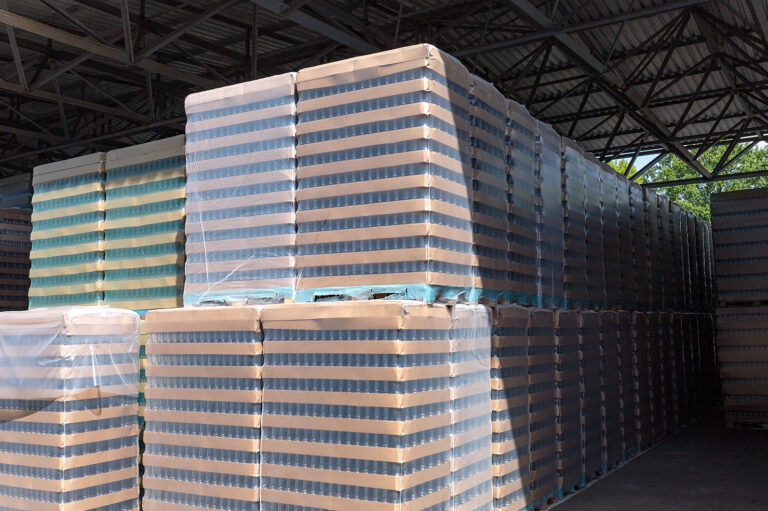
The switch to glass impacts internal warehouse logistics. Empty glass is often delivered in bulk, stacked in layers on pallets separated by tier sheets, with the load secured by shrink wrap. This is the most cost-effective delivery method but requires an automated depalletiser at the start of the production line. Or bottles can arrive pre-packed in secondary boxes, avoiding the need for a depalletiser but requiring an un-casing station.
The increased weight of full glass pallets must be factored into warehouse operations, with implications for manual handling, forklift load limits, and the weight-bearing capacity of warehouse racking systems.
The Total Cost of Ownership Framework
The migration decision can’t be made by comparing the unit price of a PET bottle against a glass bottle. The new landscape of regulatory penalties and logistical costs demands a comprehensive financial model.
Building a TCO Model for Glass Migration
Total Cost of Ownership is a comprehensive calculation of all direct and indirect costs associated with a package’s entire lifecycle. The initial unit price is often one of the smallest components.
A TCO framework for plastic-to-glass migration must include:
Direct Costs: The unit procurement price of container and closure, plus amortised capital expenditure for new machinery (cappers, depalletisers, change parts).
Regulatory Costs: The per-unit Plastic Packaging Tax (for the PET option) and, crucially, the per-unit pEPR fee for both options, calculated based on actual container weights.
Operational Costs: All costs related to running the line, including handling and labour, energy consumption, and the financial impact of line efficiency, downtime (for breakage cleanup), and product spoilage or waste.
Logistical Costs: All inbound and outbound transport and freight costs, the material cost of secondary and tertiary packaging (cases, partitions), and warehousing costs for packaging components.
Intangible Value: The commercial value generated by the packaging, including premium pricing power, brand uplift value, and the financial benefit of eliminating chemical migration risks.
The Quantifiable Value of Inertness
A key variable in TCO modelling is product spoilage. PET has a degree of gas permeability that can limit shelf life for sensitive products such as carbonated soft drinks or oxygen-sensitive juices. It also carries risks of chemical migration affecting taste.
Glass, being 100% inert and providing a perfect, impermeable barrier, eliminates these issues. This translates directly into longer, more stable product shelf life and quantifiable reduction in product spoilage. For an Operations Director, even a fractional percentage reduction in spoilage means substantial financial gain on a high-volume production line—a value that can offset higher material and logistical costs in the TCO model.
Example TCO Calculation
The following table provides an example TCO model for producing 1,000 units of a 500ml sauce. It compares a standard PET bottle, a standard glass bottle, and a lightweight glass bottle. This model integrates the legislative and logistical costs discussed and shows the financial impact of lightweighting technology.
Table 1: Example 2025 Total Cost of Ownership (TCO) per 1,000 Units
|
Cost Component |
1. Standard PET Bottle (30g) |
2. Standard Glass Bottle (400g) |
3. Lightweight Glass Bottle (280g) |
Notes |
|
A. Material & Procurement |
||||
|
Unit Price (per 1,000) |
£120.00 |
£250.00 |
£300.00 |
Example figures. Lightweight glass has higher initial technology cost. |
|
B. UK Regulatory Costs (2025) |
||||
|
Plastic Packaging Tax (PPT) |
£6.71 |
£0.00 |
£0.00 |
Assumes 0% recycled content @ £223.69/tonne |
|
Extended Producer Responsibility (pEPR) |
£12.69 |
£76.80 |
£53.76 |
PET @ £423/t; Glass @ £192/t. Note the 30% saving on pEPR for lightweight glass. |
|
C. Logistics & Handling |
||||
|
Example Transport |
£10.00 |
£40.00 |
£28.00 |
Based on relative weight ratios. Lightweighting saves 30% on transport. |
|
Secondary Packaging (per 1,000) |
£10.00 (Shrink-wrap) |
£30.00 (Case + Partitions) |
£30.00 (Case + Partitions) |
Glass requires more robust secondary packaging |
|
Subtotal (Tracked Costs) |
£159.40 |
£396.80 |
£411.76 |
|
|
D. TCO Financial Adjustments |
||||
|
Product Spoilage (Example) |
-£20.00 (2% loss) |
-£5.00 (0.5% loss) |
-£5.00 (0.5% loss) |
Glass’s inertness reduces spoilage and extends shelf life |
|
Total Cost of Ownership (TCO) |
£179.40 |
£401.80 |
£416.76 |
|
|
E. Commercial Value |
||||
|
Potential Premium RRP |
Base |
+15% |
+15% |
Glass commands premium pricing, providing margin to absorb costs |
|
TCO per Unit (Example) |
£0.179 |
£0.402 |
£0.417 |
|
|
Final Analysis |
Lowest TCO, but highest regulatory/brand risk. |
Highest TCO, driven by pEPR & transport. |
Lightweighting mitigates 30% of pEPR cost and 30% of transport costs, closing the TCO gap and retaining 100% of premium brand value. |
This TCO model shows that glass currently has a higher total cost, but the decision is strategic. The PET option carries substantial and rising regulatory risk. The lightweight glass option, though having the highest initial unit price, provides a clear, data-driven pathway to mitigating the two largest cost drivers for glass: pEPR fees and transport.
The Lightweight Glass Solution
The primary objections to glass—pEPR costs and transport weight—are being directly addressed by manufacturing innovation. Concerns about shipping weight are valid, but they’re often based on outdated perceptions of glass. Modern manufacturing technology has led to the development of modern lightweight glass alternatives that offer remarkable strength and durability with reduced mass, mitigating much of the logistical cost increase.
The average glass container is already 30% lighter than two decades ago. A standard 750ml wine bottle (typically 550g) can now be reliably lightweighted to 420g or even 350g and remain fully viable for automated filling lines. In the beer category, 330ml bottles weighing just 155g are now in production.
Advanced manufacturing processes such as chemical strengthening, hot-end coatings, and thermal hardening actually improve mechanical properties and reliability. Thermally strengthened glass bottles can be up to 30% lighter than conventional counterparts and be more durable and resistant to abrasion, lasting 20% more use cycles.
The benefits directly address the primary financial objections to glass. Lightweight bottles allow six layers of product on a pallet instead of five, improving transport efficiency and reducing CO₂ footprint per bottle. Most important for the TCO calculation: a 30% reduction in container weight delivers a 30% saving on the pEPR fee per unit.
Exploring Your Options
When you’re ready to evaluate specific container options for your migration, our online shop Jars & Bottles provides the complete catalogue of what’s available. As part of the Pattesons family, Jars & Bottles serves as your product exploration platform, where you can browse specifications, compare capacities, and identify the right containers for your application.
References
- GOV.UK, “Extended Producer Responsibility for Packaging: 2025 base fees“ https://www.gov.uk/government/publications/extended-producer-responsibility-for-packaging-2025-base-fees
- British Glass, “Think twice: British Glass warns producers against short-sighted packaging decisions“
- The Grocer, “How glass packaging can offer retailers sustainable solutions“
- Food Packaging Forum, “Scientific review reveals the chemicals migrating from PET drink bottles“
- Aegg Creative Packaging, “Glass handling on filling lines: a guideline to prevent breakages“